After months of speculation and rumors, the iPhone 6 and iPhone 6 Plus are finally here, delivering on the hopes of millions of Apple fans looking for a boost in size, speed and overall power.
Unveiled Tuesday at the Flint Center in Cupertino, California, not far fromApple's headquarters, the new flagship iPhone 6 comes with a 4.7-inch screen and 16, 64 or 128GB of storage. The larger iPhone 6 Plus has a 5.5-inch screen and the same storage options.
But while we all know that the new iPhones have a built-in supply of eager consumers ready to snap them up, those still on the fence might be wondering how the devices stack up against the competition.
We put together a handy chart to give you a basic idea:
iPhone 6 and iPhone 6 Plus vs. Galaxy S5 vs. HTC One M8 vs. Lumia 930 vs. Moto X
iPhone 6, 6 Plus
Galaxy S5
HTC One M8
Lumia 930
Moto X
Screen Size
4.7, 5.5 inches
5.1 inches
5 inches
5 inches
5.2 inches
Resolution
1334 x 750 (6), 1920 x 1080 (6 Plus)
1920 x 1080
1920 x 1080
1920 x 1080
1920 x 1080
Screen Type/ppi (pixels per inch)
Retina HD display, 326 ppi (6), 401 ppi (6 Plus)
Super AMOLED, 432 ppi
Super LCD3, 441 ppi
ClearBlack, OLED, 441 ppi
OLED, 423 ppi
Weight
4.55 oz (6), 6.07 oz (6 Plus)
5.1 oz
5.6 oz
5.89 oz
5 oz
Chipset
A8 64-bit chip w/ M8 motion coprocessor
2.5GHz Qualcomm Snapdragon 801 with quad-core CPU
2.3GHz Qualcomm Snapdragon 801 with quad-core CPU
2.2GHz Qualcomm Snapdragon 800 with quad-core CPU
2.5GHz Qualcomm Snapdragon 801 with quad-core CPU
Storage
16GB, 64GB, 128GB (both models)
16GB, expandable via microSD up to 128 GB
16GB, 32 GB, expandable via microSD up to 128 GB
32GB, no card slot
16 GB (32GB available through MotoMaker)
Connectors
Apple Lightning
microUSB
microUSB
microUSB
microUSB
Operating System
iOS 8
Android 4.4.2 (KitKat)
Android 4.4.2 (KitKat)
Windows Phone 8.1
Android 4.4.2 (KitKat)
Battery
TBD
2800 mAh
2600 mAh
2,300mAh
2,000 mAh
Camera
8MP iSight w/ TrueTone flash, FaceTime camera 1.2MP
rear camera 16MP with LED flash, front camera 2MP
rear camera Dual 4MP, front camera 5MP
rear camera 20MP Dual LED flash, front camera 1.2MP
rear camera 13MP, front camera 2MP , LED flash
Networking
Wi-Fi 802.11c, Voice over LTE, supports 20 LTE bands
Wi-Fi 802.11ac, 2G, 3G, 4G LTE
Wi-Fi 802.11ac, 2G, 3G, 4G LTE
Wi-Fi 802.11ac, 2G, 3G, 4G LTE
Wi-Fi 802.11ac, 2G, 3G, 4G LTE
U.S. Price (with 2-year contract)
iPhone 6 $199, $299, $399, 6 Plus $299, $399, $499
$149 (price may vary depending on carrier)
$49.99 (price may vary depending on carrier)
$599 (unlocked)
$99 (price may vary depending on carrier)
Have something to add to this story? Share it in the comments.
The company announced on Thursday it is refreshing its apps to take advantage of Flickr's image recognition abilities. The move is part of a greater effort to improve search, organizational features and streamline the uploading process, which will make it easier to move photos off your devices.
The iOS and Android apps have been reworked so the experience feels the same on both apps as well as on the web.
A revamped version of Camera Roll will let you view all the photos and videos you've ever uploaded to your Flickr account; you can sort your photo catalog by date or use a new "magic view" feature that automatically sorts your photos into categories, such as black and white, landscapes, screenshots and animals using image recognition. The feature will sort images into more than 60 categories so you can easily view similar photos at once.
Flickr's new "magic view" which uses image recognition to automatically sort your photos.
In addition, the service is leveraging its image recognition abilities to dramatically improve its search. Flickr is now better able to detect what type of photo you're looking for and weed out irrelevant results.
"Look for photos of the London Eye to find the giant Ferris wheel, and you'll no longer find countless photos of eyes taken in London," Flickr's head of engineering, Tim Miller, wrote in a Tumblrpost. "Instead, our new advanced search algorithms understand your intent and bring you higher quality results time after time."
Flickr's new and improved web search
These search tools also apply to searching your own photos; you can look for images based on subject, such as specific holidays, locations or dates.
Finally, the update adds new uploading tools for Windows and Mac, permitting uploads up to 500,000 photos to one account as once. This is a good way to take advantage of that 1,000 GB of free storage Flickr offers.
Have something to add to this story? Share it in the comments.
Volkswagen's Apple Watch app will be an addition to the company's Car-Netsystem, which already works through an iOS app on the iPhone.
Through that app, users can remotely track their car via GPS, set speed and distance limits (when children borrow the car) and can be automatically assisted byVW when the system senses that the car's airbags have been deployed.
The iPhone app also offers detailed diagnostics and maintenance information, eliminating the mystery behind your car's latest glitch, and making a trip to the mechanic a bit more efficient.
Car-Net is currently available on select 2014 and later Volkswagen models, including the Golf, Passat, Jetta and the Beetle.
It's still not clear whether or not all the iPhone app functions will make it to the Apple Watch app. However, in screenshots released Tuesday, the company did show off Apple Watch app screens displaying temperature information, location mapping and car battery charge indicators. Additionally, the company confirmed that users will be able to use the Apple Watch app to remotely lock and unlock car doors and set speed and boundary alerts.
Although Volkswagen's announcement promises that the Apple Watch app will "be available," the company did not immediately respond to a request for comment on when it will be ready for download.
Have something to add to this story? Share it in the comments.
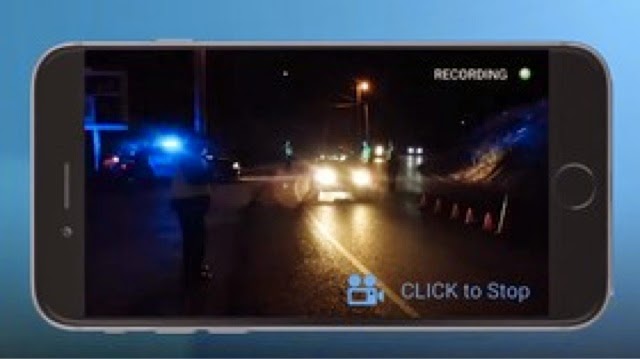
In a time when nearly everyone, regardless of income, seems to have a smartphone, the ACLU has come up with something that could help during your next encounter with an overzealous law enforcement officer: an instant reporting app.
Mobile Justice CA was created by the Southern California branch of the American Civil Liberties Union as a way to "keep law enforcement accountable and protect your rights."
Available for iOS and for Android, the free app allows users to instantly record and send a video of a police encounter to the ACLU.
Additionally, the app also allows you to turn on GPS tracking so that you can be notified if anyone else using the app near your location reports an incident. In light of recent demonstrations against police brutality, the app could be seen as essential equipment for some engaging in peaceful protests.
The app also includes a list of U.S. rights, giving the user an additional tool in potentially touchy situations involving police encounters, as well as free speech and student rights demonstrations.
It comes on the heels of recent high-profile police brutality cases that used bystander videos to show what really happened, such as the death of Walter Scoot in South Carolina, which resulted in the responsible officer being charged with murder.
That such an app is even necessary may itself serve as a commentary on U.S. law enforcement policies, which are still evolving every day. But, in the meantime, the ACLU's app is one tech-powered answer to the many questions swirling around recent, politically charged events in the U.S.
Have something to add to this story? Share it in the comments.
At its annual Build conference, Microsoft showed off some new features ofWindows 10, including a more transparent look and feel.
Microsoft's Joe Belfiore, corporate vice-president of the operating system group, unveiled updates to Cortana and the company's new web browser, Microsoft Edge (originally called Project Spartan).
One of the big visual changes to Windows 10 is the re-addition of the transparent Aero Glass look from Windows Vista and Windows 7. "We're trying to bring back some of that feel," Belfiore said.
And it's a good decision, as Aero Glass has aged far better than other UI paradigms. In fact, Apple embraced Aero Glass-ness with its latest desktop operating system, OS X Yosemite.
In addition to its Start menu, Microsoft is bringing back Jump Lists. Windows 10 will also use a new Spotlight feature to show users interesting images on their desktop's lock screen and various Windows 10 apps. Users can then choose to install an app directly from the lock screen (this feature can be turned off).
More ways to get into the Windows Store
Microsoft announced new ways for developers to get apps to its platform and inside the Windows Store.
Until now, developers have had to package their apps as Windows Universal apps for the Windows Store.While that's fine for new apps written with more modern design language, traditional applications written in Win32 or .NET are unable to be added to the Windows Store.
That changes with Windows 10. Now, Microsoft is allowing developers to package their Win32 and .NET apps to sell in the Windows Store.
To ensure security, those apps will be run sandboxed, so they don't harm other parts of the system.
This is big news for traditional app makers. Adobe has already said it will be bringing Adobe Photoshop Elements and Adobe Premiere Elements to the Windows Store.
The viral Microsoft site designed to guess your age, How Old Do I Look, may have a down side: keeping your photos in the company's product ecosystem.
Some users have noticed that despite the site's front-page message saying, "We don't keep the photo [uploaded to the site]," its terms of service suggest something different.
Following a sentence declaring that "Microsoft does not claim ownership of any materials you provide," a subsequent passage in the site's terms of service reveals an important caveat:
However, by posting, uploading, inputting, providing, or submitting your Submission, you are granting Microsoft, its affiliated companies, and necessary sublicensees permission to use your Submission in connection with the operation of their Internet businesses (including, without limitation, all Microsoft services), including, without limitation, the license rights to: copy, distribute, transmit, publicly display, publicly perform, reproduce, edit, translate, and reformat your Submission.
But that's not all. Its terms of service also includes the right for Microsoft to "publish your name in connection with your Submission; and to sublicense such rights to any supplier of the Website Services."
IMAGE: MICROSOFT
The messages appear to directly conflict with each other: One promises that Microsoft won't keep your photos, while the other states quite clearly that you are giving Microsoft permission to use them.
When contacted by Mashable, a Microsoft spokesperson explained the apparent discrepancy.
"How-old.net does not store or share the pictures," the spokesperson said. "The terms of service are accurate.Developers get to choose how their apps work. The developers of How-old.net chose not to store or share photos for this app. These terms of services are like those of other companies."
In other words, How Old Do I Look doesn't intend to store your photos, but its terms of service give Microsoft the right to handle anything uploaded to the site should it see fit.
Have something to add to this story? Share it in the comments.
Microsoft Principal Program Manager Scott Hanselman speaks at the Microsoft Build conference in San Francisco, Wednesday, April 29, 2015.
IMAGE:
Microsoft caught many off guard Wednesday when the company announced it would be embracing almostall developers in Windows 10, even if they develop primarily for competing operating systems.
In a significant departure from its previous mobile strategy, Microsoft is now welcoming iOS and Android developers to Windows — part of its more ambitious plan to get Windows 10 on one billion devices within "two or three years," as Microsoft's executive vice president Terry Myerson noted.
But if Microsoft wants to get on a billion devices, it will need to address its lingering app problem. Despite previous efforts to inspire developers, Windows is still far behind iOS and Android in terms of quantity (and, in many cases, quality) of apps. The Windows and Windows Phone Store together have 585,000 apps, according to Microsoft, while Android and iOS both have well over a million.
Closing this gap, and winning over developers, will be key to Microsoft's 1 billion devices goal, which is why the company is now turning to iOS and Android developers. The company is appealing to them through something it calls Universal Windows Platform Bridges, a series of programs that allow developers to port iOS, Android, web and and classic Windows apps to Microsoft's new Universal App Platform.
IMAGE: MICROSOFT
Android developers will take advantage of a program called Project Astoria while iOS developers will have Project Islandwood. The specifics of these programs are not yet clear — interested developers can sign up now to become early users — but Microsoft says both projects will only require a few minor changes to an app's existing code to make them Windows Phone-ready.
In theory, this seems like a huge win for developers and Windows users alike. Developers now have a way to support a new platform with minimal extra work while Windows Phone users stand to benefit from an expanded app catalog.
Back in the real world, however, many developers are not yet convinced.
Is it worth the effort?
Although the ability to reuse code is nice, plenty of developers we spoke with said simply having that ability wouldn't change their decision about whether or not to target Windows or Windows Phone.
Moshe Berman, a Brooklyn College '16 student who has developed on iOS says the announcement is "interesting" but that he has enough on his plate handling current projects.
"I'm definitely excited to see where this new Microsoft of open source is going, and this is a welcome move. How effective it is remains to be seen," Berman says.
It's also worth noting that for plenty of developers, the issue isn't so much around porting over code, but around maintenance and support.
@film_girl No. There's still not a large enough user base to be worth the trouble of Dev + Testing + Support.— Bryan O'Malley (@bryanomalley) April 29, 2015
@film_girl no. We dropped all WinPhone & blackberry apps because of support & maintenance costs
Plenty of developers we talked to said the big problem they face is that there still aren't enough users on Windows Phone or who buy apps from the Windows Store on the desktop to necessitate the effort — even if it is minor — to move.
One lead iOS developer for a large social network told Mashable that this doesn't change his company's perspective towards Windows at all. The service has active development teams for Android and iOS, but last updated its Windows Phone app in 2013.
Another leading indie iOS developer toldMashable that "while this theoretically lowers the bar quite a bit, the biggest issue is still that there's effectively no installed base, and even if you try targeting the entire Windows desktop platform as well, there simply aren't many Windows users who buy apps like what most iOS developers make."
"So it solves a problem, but not theproblem."
@film_girl It's not enough to build it, but we'll have to maintain it, so chances are we won't until we have enough requests for it.— Michael Gaines (@starmike) April 29, 2015
The problems with porting
No matter how much Microsoft would like to pretend otherwise, developers are skeptical that it will really be that easy to actually bring code over to Windows from iOS or Android. At least, if you want an app to work correctly.
@film_girl we built Pocket Casts natively for windows phone. Porting never ends well
Shane Elliott, the director of technology solutions at Stellar Digital Design Agency, points out that the "write once, deploy everywhere" solution "isn't exactly new." The problem with these solutions, Elliott says, is that "it never comes without the usual steep learning curve and migration cost in terms of time."
"The issue is that in order to get fully native, optimized code deployed on a platform, you simply can't get all the way there unless you write it natively. Doing otherwise requires my team to rely on some level of automation to compile the code down. I'm not convinced this is a problem that's been solved yet."
Still, that's not even why Elliott won't be moving any of his code over to Windows from iOS or Android. For Elliott, it's the migration itself that's the biggest problem.
Since the code originates on a different platform, the code will still need to be restructured to some extent — what's called refactoring — to make it ready, Elliott explains, saying the idea of Microsoft replacing existing Google APIs sounds "like a terrifying prospect."
"In the end, I'd need to be convinced that I'm making the effort to move and refactor all that code onto a platform that offers some advantage," he says. "In terms of user base, Windows simply can't compete. So moving code to the platform with the smallest user base is just philosophically unwise."
Elliott notes Microsoft's approach feels like a move to win over new developers, rather than to migrate experienced ones. Still, he thinks Microsoft may eventually get to be where it wants to be, if it continues on the path of cross-platform development.
Elliott brings up a good point when it comes to refactoring and re-assessing what parts of the APIs are supported by Microsoft's new tools, and what parts need to be rewritten. For apps such as Candy Crush Saga — and potentially for clients for apps such as Snapchat or Instagram — the time necessary to port over code, even with optimizations, could still pale in comparison to taking the time to dedicate resources specifically for Windows.
It's also true that the less complex the app, the more it would makes sense to use the code-sharing tools. But for apps with very custom user interfaces and custom or complex API usage, porting code over will likely require a lot of work to get things to compile under Windows, and that's before we even talk about optimization.
The problem for Windows developers
Meanwhile, many experienced Windows developers are also troubled by Microsoft's more inclusive developer strategy. Those who have spent careers creating Windows apps are now concerned about their place in Microsoft's new ecosystem as iOS and Android developers can easily take their place.
To be clear, there will still be a need for developers who can create native Windows apps, particularly in the enterprise space. And, unlike BlackBerry's Android push, developers will still need to do some work to make their apps ready for the move, so knowledge of Windows will still be a valuable asset.
On its part, Microsoft has suggested this tension will sort itself out as users get a chance to actually get their hands on apps and provide developers with feedback. And executives maintain more apps and more developers will only make the platform stronger.
"Fundamentally, we believe that it's sort of the free market-system," Microsoft's head of Windows Phone Joe Belfiore said during a developer session at Build. "The end users will use ratings and in-app purchases to decide what they value the most, and that feedback goes back to developers, and you get a better result. So I don't think we're going to suddenly lose Windows 10's or Windows Phone's unique personality."
It's still worth a shot
The reality is, Microsoft is way behind in developer mindshare when it comes to mobile. That creators of some of the biggest apps on iOS and Android — Snapchat, Instagram and Lyft, to name a few — are nonexistent or ignored for years on Windows Phone has long been one of the platform's biggest, and most difficult to fix, problems. The best way to get developers to even consider Windows is to say, "hey, bring your code over to us from your platforms of choice."
If even a fraction of iOS or Android developers are willing to explore options on Windows, that could be enough to help Microsoft begin to finally catch up.
Have something to add to this story? Share it in the comments.